Crown Thinning: A Better Way to Manage a Dense Tree Canopy

A tree doesn’t have to be too tall or too wide to create a pruning concern. Sometimes the problem is simply density.

As mature trees grow, branches can become crowded, overlap, cross, or compete for space. A dense canopy may also block desired views or create localized clearance concerns.

The instinct may be to remove large portions of the tree. But if the tree’s overall size is appropriate, making it smaller isn’t necessarily the answer.

Crown thinning can help manage excessive canopy density while preserving much of the tree’s overall height, spread, and natural form.

Unlike tree topping, which removes major portions of the canopy, or crown reduction, which is primarily used to decrease a tree’s overall dimensions, crown thinning involves the selective removal of appropriate branches throughout the canopy.

The objective isn’t to strip the tree open or remove as many branches as possible. It’s to create a more evenly distributed canopy while retaining enough healthy foliage and structural branches for the tree to continue developing normally.

Arborist Insight: A dense tree isn’t automatically an unhealthy or hazardous tree. Before removing branches, an arborist should determine whether the density is actually creating a problem—and whether thinning is the appropriate solution.

What Is Crown Thinning?

Crown thinning is a pruning technique that selectively removes branches throughout a tree’s canopy to reduce excessive density and improve the distribution of remaining branches and foliage.

Unlike crown reduction, the primary objective is not to make the tree shorter or smaller.

Instead, an arborist selectively removes certain branches while leaving the overall dimensions of the canopy largely intact.

Crown thinning may address:

  • Crowded or overlapping branches
  • Poorly distributed growth
  • Selected branches that are rubbing or competing
  • Excessive density in specific areas
  • Branches that can be removed without compromising the tree’s overall structure

The arborist works throughout the canopy rather than simply cutting the outer ends of branches. The goal is to maintain a natural appearance while improving the distribution of foliage.

The Goal Isn't to Make the Tree "See-Through"

One common misconception is that a properly thinned tree should allow you to see clearly through the entire canopy.

That’s not the objective.

Trees need foliage to produce energy through photosynthesis. Removing too many branches can reduce the tree’s ability to support itself and may encourage undesirable growth.

Good crown thinning creates space within the canopy without stripping the tree of the foliage it needs.
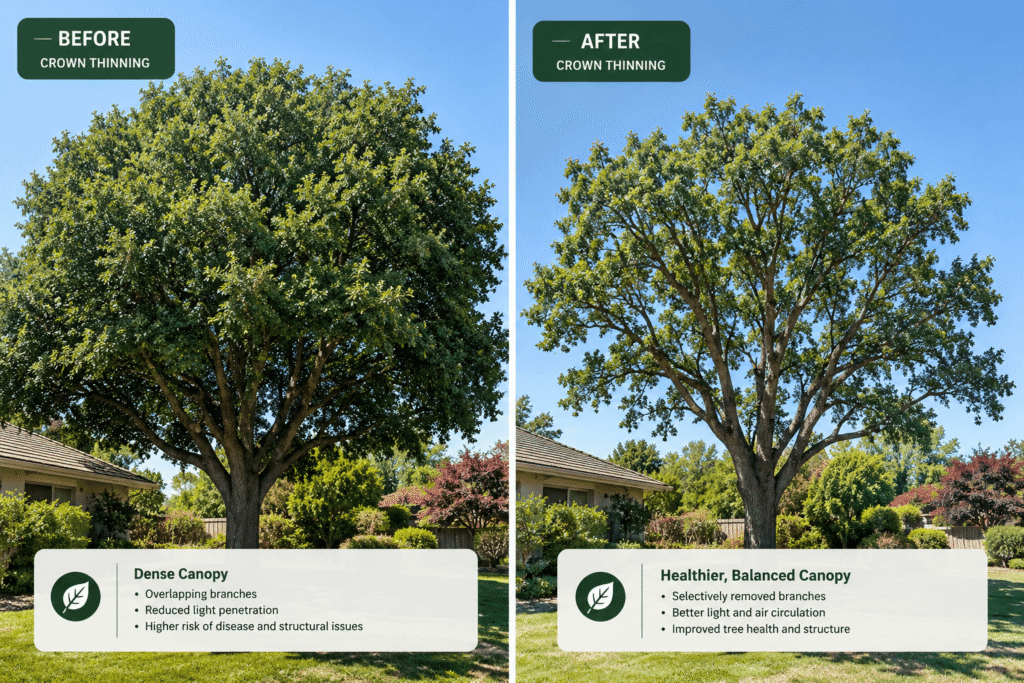
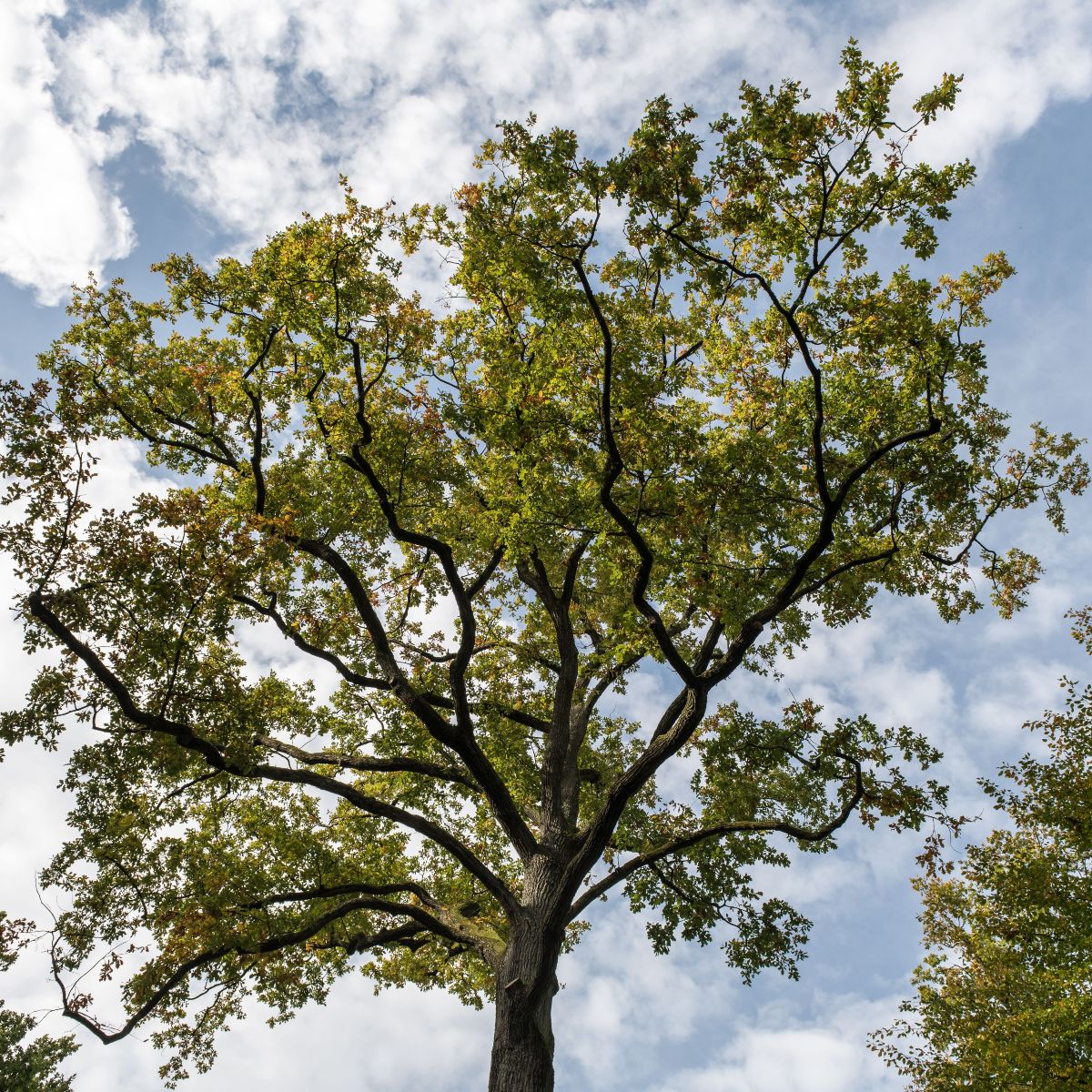
Crown thinning selectively reduces canopy density while maintaining the tree’s overall height, spread, and natural form.

Crown Thinning vs. Crown Reduction

Crown thinning and crown reduction are often confused because both involve selective pruning. However, they address different problems.

Too large? Think crown reduction. Too dense? Think crown thinning.

Crown Thinning Crown Reduction
Primary goal Reduce canopy density Reduce tree height and/or spread
Main concern Crowded or overly dense canopy Tree has outgrown its space
Overall height Generally remains similar Decreases
Overall spread Generally remains similar Decreases
Pruning approach Selective branch removal throughout the canopy Selective shortening of branches
Typical result More evenly distributed canopy Smaller, more manageable canopy

If the tree’s overall size is appropriate but certain portions have become crowded, crown thinning may be considered.

If the primary concern is that the tree has become too tall or too wide for its surroundings, crown reduction may be more appropriate.

The distinction matters because using the wrong technique may fail to address the homeowner’s actual concern. Trying to make a very large tree smaller through thinning, for example, doesn’t solve the problem of excessive height or spread.

Arborist Insight: Pruning should begin with the problem you’re trying to solve—not with a particular pruning technique you’ve heard about.

When Is Crown Thinning Appropriate?

Crown thinning can be appropriate when a tree’s overall size is acceptable but its canopy has become excessively crowded or unevenly distributed.

The decision should be based on the tree’s condition and the specific concern—not simply on how dense the canopy looks from the ground.

When Branches Are Crowded or Overlapping

As trees mature, branches can grow into one another and compete for space. Some may cross or rub against neighboring branches, while others create dense clusters within the canopy.

Selective thinning can address appropriate branches within these crowded areas while leaving the rest of the canopy intact.

When Growth Is Unevenly Distributed

Changes in sunlight, surrounding vegetation, previous pruning, and site conditions can cause certain portions of a canopy to become significantly denser than others.

An arborist can selectively remove branches from crowded areas to create a more balanced distribution of foliage.

When You Want to Improve Visibility Through Portions of the Canopy

A homeowner may want to open a limited portion of the canopy around a driveway, walkway, window, or particular view.

Selective thinning may help accomplish this without substantially reducing the tree’s overall size.

However, visibility alone shouldn’t justify removing large amounts of healthy foliage.

When Specific Branches Are Poorly Positioned

Not every pruning job needs to involve the entire canopy.

If only certain branches are poorly positioned, damaged, crowded, or competing with better-placed growth, selective removal may address the concern without significantly changing the tree’s overall appearance.

The advantage of a targeted approach is that the arborist can remove specific problem branches rather than treating the entire canopy as a problem.

When Crown Thinning May Not Be the Right Solution

Crown thinning isn’t a universal way to make a tree safer or healthier.

It may not be appropriate when:

  • The tree is simply too large: Thinning generally does not significantly reduce overall height or spread. Crown reduction or another approach may be more appropriate.
  • The tree is already sparse or declining: Removing additional healthy foliage may place unnecessary stress on a tree that is already struggling.
  • The main problem is structural: Significant decay, cracks, weak unions, or other defects may require specific corrective work rather than general thinning.
  • The goal is to dramatically open the canopy: Removing large amounts of foliage simply to make a tree look “airy” can cause unnecessary stress.
  • The requested pruning is excessive: If the desired result requires removing a substantial portion of the canopy, the arborist should reassess whether thinning is appropriate at all.

Arborist Insight: More open doesn’t necessarily mean healthier or safer. A tree needs sufficient foliage to produce energy, and its branches provide the structure that supports the canopy. Good thinning removes what is appropriate—not everything that looks crowded.

How Does Crown Thinning Work?

Professional crown thinning is a selective process, not a matter of randomly removing branches until the canopy looks more open.

An arborist generally works through four stages:

1. Assess

The tree is evaluated from different viewpoints to understand how branches and foliage are distributed.

The arborist looks for crowded areas, crossing or rubbing branches, damaged growth, structural concerns, and other factors that may influence the pruning plan.

2. Select

Individual branches are identified for removal based on their position, condition, and contribution to the overall canopy.

The goal is selective removal, not uniform removal from every part of the tree.

3. Distribute

Pruning is distributed throughout the canopy as appropriate rather than concentrating excessive removal in one area.

This helps maintain a balanced appearance and avoids unnecessarily disrupting the tree’s structure.

4. Reassess

After selected branches are removed, the arborist evaluates the canopy again.

This helps prevent over-thinning, where the goal becomes making the tree look as open as possible rather than addressing the original concern.

The goal of crown thinning isn’t to remove a certain number of branches. It’s to achieve the appropriate reduction in canopy density while retaining a healthy, balanced tree.
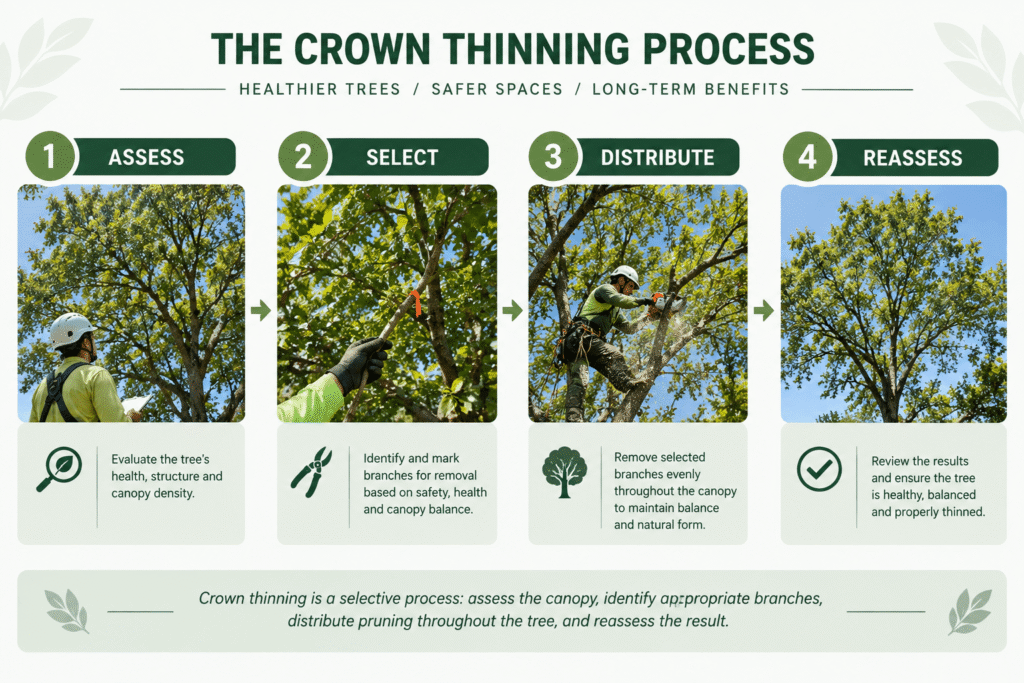
Crown thinning is a selective process: assess the canopy, identify appropriate branches, distribute pruning throughout the tree, and reassess the result.

Benefits of Crown Thinning

When crown thinning is appropriate and performed selectively, it can help manage a crowded canopy without substantially changing the tree’s overall dimensions.

Maintains Overall Tree Size

Unlike crown reduction, thinning generally doesn’t aim to make the tree shorter or narrower. The tree can retain much of its established height and spread.

Reduces Canopy Crowding

Selective branch removal can improve the distribution of foliage where growth has become overly concentrated.

Addresses Branch Competition

When branches overlap, cross, or compete for the same space, selective removal can help reduce unnecessary crowding.

Preserves Natural Appearance

Because thinning is performed selectively throughout the canopy, the objective is to maintain the tree’s natural form rather than create a flat or artificially sparse appearance.

Can Address Specific Visibility Concerns

In appropriate situations, selective thinning can open limited portions of the canopy around a driveway, walkway, window, or view without substantially reducing the tree’s overall size.

How Much Should a Tree Be Thinned?

There is no single percentage that applies to every tree.

The appropriate amount depends on the species, canopy density, health, structure, growing conditions, and previous pruning history.

A tree that is already stressed or sparse may require little or no thinning, while a healthy tree with significant localized crowding may tolerate more selective removal.

For that reason, professional thinning should not be based on a predetermined promise such as “We’ll remove 20% of the tree.” The arborist should evaluate the canopy and determine which branches can reasonably be removed.

More thinning does not mean better thinning.

Removing excessive foliage can leave a tree unnecessarily stressed and may encourage undesirable regrowth. The goal is to remove enough to address the specific concern—without removing more than necessary.

What Happens After Crown Thinning?

Crown thinning doesn’t stop a tree from growing.

The tree will continue producing new foliage and branches, gradually filling some of the space created by pruning. How quickly this happens depends on the species, health, growing conditions, and growth rate.

Immediately after pruning, the canopy may look somewhat more open. Over time, new growth develops and the tree’s appearance becomes more natural again.

The objective isn’t for the tree to remain permanently sparse.

The goal is to create a better-distributed canopy that can continue developing naturally.

Future maintenance may eventually be appropriate, particularly for fast-growing trees or trees with recurring clearance concerns. However, pruning should be based on the tree’s growth and condition—not an arbitrary schedule.

Frequently Asked Questions About Crown Thinning

It can address certain branch-crowding or clearance concerns, but thinning should not be presented as a guarantee against storm damage or tree failure.

Overall tree risk depends on factors including structural defects, decay, branch attachments, roots, species, site conditions, and nearby targets.

Generally, no. Crown thinning is primarily intended to reduce canopy density, while overall height and spread remain relatively similar.

If the main concern is excessive height or spread, crown reduction may be more appropriate.

There is no universal schedule. Future pruning depends on the tree’s species, growth rate, condition, site, and how the canopy develops after the initial work.

No. Some trees may be too stressed, sparse, structurally compromised, or otherwise unsuitable for additional canopy removal. A professional assessment should come before significant pruning.

Improper or excessive thinning can. Removing too much healthy foliage can reduce the tree’s ability to produce energy and may encourage undesirable growth.

That’s why professional thinning focuses on selective removal rather than maximum removal.

Neither technique is universally better. They solve different problems.

If the tree is too large, crown reduction may be appropriate. If the tree is appropriately sized but excessively dense, crown thinning may be the better fit.

Not Sure Which Pruning Approach Your Tree Needs?

A dense canopy doesn’t necessarily mean a tree needs to be heavily pruned. Likewise, a large tree doesn’t automatically need to be reduced.

The right approach depends on what is actually happening with the tree.

JC Tree Service can evaluate your tree’s structure, health, canopy density, surroundings, and pruning history to determine whether crown thinning, crown reduction, another pruning strategy, or no major pruning is appropriate.

Our goal is not to remove as much as possible. It’s to perform the right work for the tree and the property.
Crown Reduction: A Safer Alternative to Tree Topping

Crown reduction is a professional tree-pruning technique used to reduce a tree’s height and/or spread while retaining its natural structure and functional canopy.

When a mature tree becomes too large for its surroundings, homeowners often look for a way to make it smaller. Maybe branches are approaching the roof, the canopy is extending over a driveway, or the tree’s height has become a concern during storms.

The obvious solution can seem to be cutting the top off.

But tree topping can create serious long-term problems rather than solving the original concern. As we explained in our guide to [Tree Topping], removing large portions of a tree’s canopy can lead to weak regrowth, decay, structural problems, and repeated maintenance.

So what can you do when a tree genuinely needs to be reduced in size?

Crown reduction may provide a safer, more controlled alternative to topping when the tree and site are suitable for the technique. Rather than cutting branches back to arbitrary points, crown reduction selectively shortens branches while retaining an appropriate framework of lateral branches.

The goal isn’t simply to make a tree shorter. It is to manage its height or spread while preserving as much of its natural structure and function as reasonably possible.

Arborist Insight: A tree being “too big” doesn’t automatically mean it needs crown reduction. The right question is whether its size can be managed without unnecessarily compromising its long-term structure and health.

What Is Crown Reduction?

Crown reduction is a professional pruning technique used to decrease a tree’s overall height and/or spread while maintaining a functional, natural-looking canopy.

Instead of removing large sections of the upper canopy, an arborist selectively shortens branches back to suitable lateral branches. These remaining branches can continue the growth pattern of the shortened limbs without leaving large, arbitrary stubs.

Crown reduction may involve a technique commonly known as drop-crotch pruning, where a larger branch is reduced back to a suitable lateral branch that can assume the role of the shortened branch.

The arborist considers the tree’s species, health, existing structure, previous pruning, surroundings, and the amount of reduction actually needed. The objective is to achieve the minimum practical reduction necessary to address the property’s concern while leaving the tree with a functional canopy.

Crown Reduction Is Not the Same as Tree Topping

Both techniques reduce the size of a tree, but the similarity largely ends there.

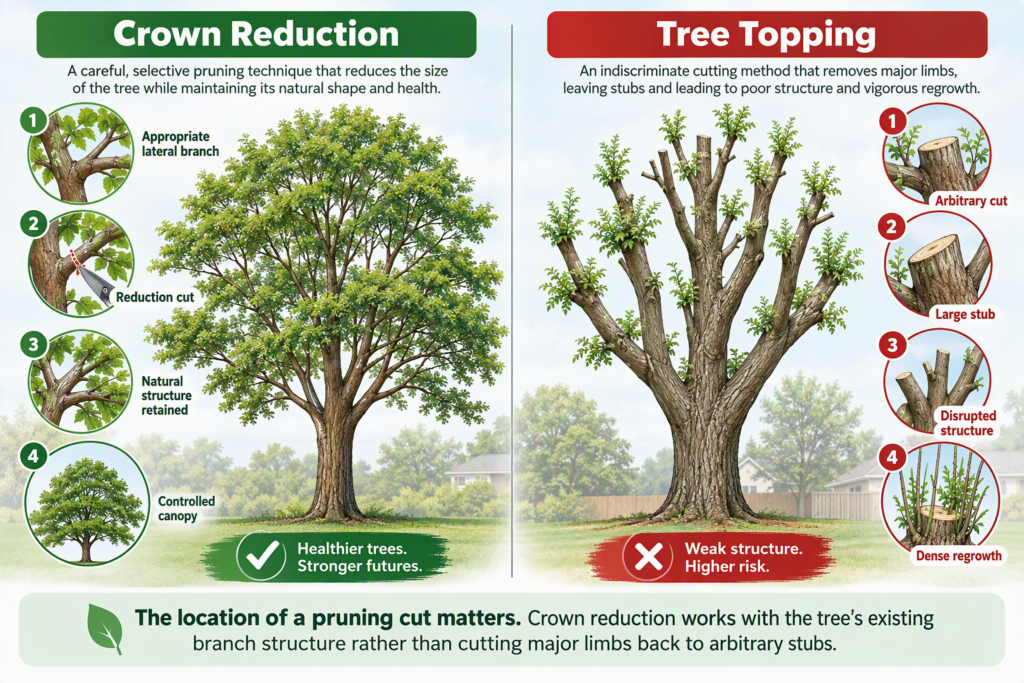
Tree topping cuts major branches back to arbitrary points or large stubs, removing substantial portions of the canopy and disrupting the tree’s natural structure.

Crown reduction selectively shortens branches back to appropriate lateral branches within the existing framework.

The goal is not to make a tree as small as possible. It is to manage its dimensions while retaining as much of its natural form and structural integrity as reasonably possible.

Illustration comparing proper crown reduction pruning with improper tree topping

The location of a pruning cut matters. Crown reduction works with the tree’s existing branch structure rather than cutting major limbs back to arbitrary stubs.

How Does Crown Reduction Work?

Crown reduction isn’t simply a matter of deciding how many feet to remove from the top of a tree. An arborist first evaluates the tree and identifies which portions of the canopy can be reduced while maintaining a reasonable structure.

Assessing the Tree and Its Surroundings

The arborist looks at major leaders, branch attachments, overextended limbs, dead or damaged wood, existing decay, and areas of congestion within the canopy.

The surrounding property matters too. A branch extending toward a roof, driveway, walkway, or utility line may require a different approach from one growing safely into open space.

This assessment determines whether reduction can address the homeowner’s concern without creating new problems.

Selecting the Right Reduction Points

Once the branches requiring reduction are identified, the arborist selects appropriate lateral branches where cuts can be made.

The remaining lateral should be appropriately positioned and capable of continuing the branch’s growth pattern.

Arborist Insight: Good crown reduction isn’t about finding the shortest branch to cut. It’s about finding the right branch to leave behind.

Making Proper Pruning Cuts

The location and quality of each cut matter. Branches have natural anatomical structures that help trees respond to pruning wounds.

Where a branch joins a larger limb or trunk, the branch collar forms part of the tree’s natural defense system. Proper pruning respects this structure rather than unnecessarily cutting into it or leaving excessive stubs.

The size and location of each proposed cut also matter. This is why professional crown reduction shouldn’t be treated as a simple “cut X feet off the tree” service.

Maintaining Balance Throughout the Canopy

An arborist doesn’t necessarily remove an identical amount from every branch.

Reduction is performed selectively throughout the canopy to maintain reasonable balance and preserve the tree’s overall appearance and structure.

The finished tree should still look like the same tree—just better suited to its surroundings.

Considering Future Growth

A professional pruning plan also considers what happens after the job.

Branches will continue to grow, so the arborist considers where that growth is likely to develop and whether today’s pruning will create future clearance or structural problems.

Good pruning considers the next stage of the tree’s growth, not just how the tree looks on the day of the job.

When Is Crown Reduction Appropriate?

Crown reduction is generally appropriate when a healthy, structurally suitable tree has outgrown its available space and a reasonable reduction in height or spread can address the concern without excessive canopy removal.

When a Tree Has Outgrown Its Space

A tree that was appropriately sized when planted may eventually grow well beyond the space available to it.

If branches are extending toward a roof, driveway, walkway, or property boundary, crown reduction may help bring the tree’s dimensions back within more manageable limits—provided the desired reduction is reasonable for the tree.

When Clearance Is Becoming a Problem

Branches may eventually grow too close to structures or other areas requiring clearance.

In some cases, only specific portions of the canopy need attention. An arborist can determine whether targeted pruning is sufficient or whether broader reduction is warranted.

When Excessive Height or Spread Is the Main Concern

If a healthy, structurally sound tree has simply become too large, crown reduction may be considered to manage excessive vertical height, lateral spread, or overextended portions of the canopy.

The key is that the desired reduction must be achievable without removing an excessive amount of healthy canopy.

When Crown Reduction May Not Be the Right Solution

Crown reduction isn’t appropriate for every tree.

A different approach may be necessary when:

  • The tree is severely declining or already under significant stress.
  • Major decay, cracks, weak unions, or other structural defects require specific corrective work.
  • The species does not respond well to substantial reduction.
  • The tree has already been topped or heavily pruned.
  • The homeowner wants the tree reduced far beyond what its structure can reasonably support.
  • The tree fundamentally cannot fit its location without repeated drastic pruning.

In these situations, an arborist may recommend selective pruning, crown thinning, structural pruning, ongoing monitoring, or, when a tree is genuinely hazardous and cannot reasonably be retained, removal.

Practitioner Insight

If a tree has to be drastically shortened to fit its location, the problem may not be the tree’s height—it may be the tree’s relationship with the site.

The objective of professional tree care isn’t to force every tree into an artificially small size. It is to determine what management approach makes sense for that tree, on that property, over the long term.

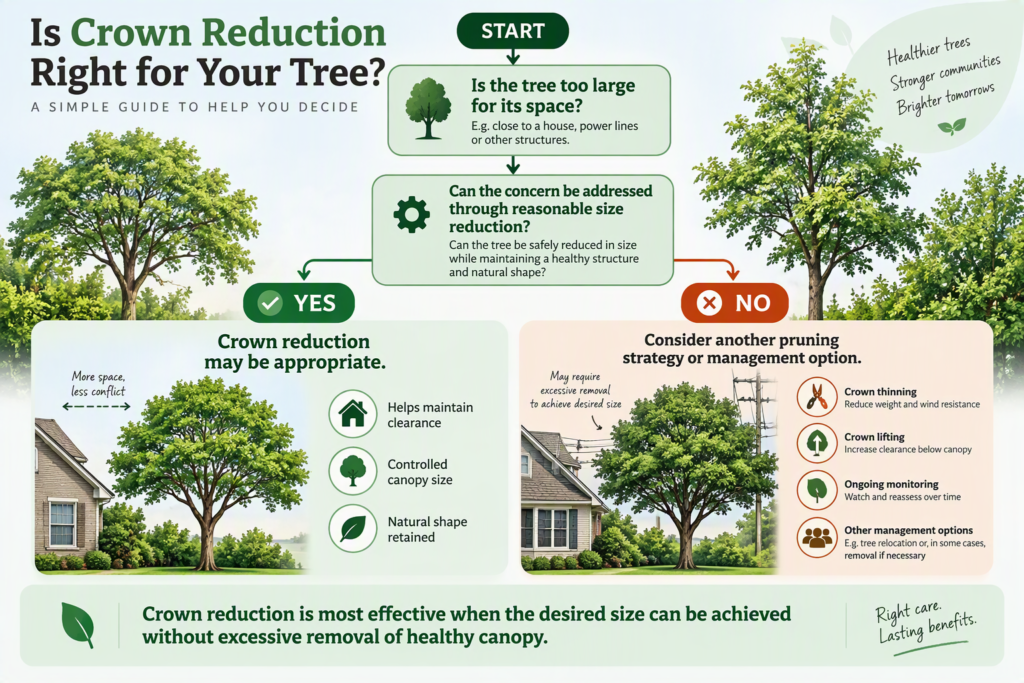
Crown reduction is most effective when the desired size can be achieved without excessive removal of healthy canopy.

Crown Reduction vs. Crown Thinning

Crown reduction and crown thinning are both professional pruning techniques, but they address different concerns.

Crown Reduction Crown Thinning
Primary goal Reduce height and/or spread Reduce excessive canopy density
Main concern Tree is too large for its space Canopy is too dense or crowded
Overall size Decreases Generally remains similar
Pruning approach Selectively shortens branches Selectively removes branches throughout the canopy
Typical result Smaller, manageable canopy More open, balanced canopy

A simple way to think about the difference:

If the problem is “My tree is too large,” crown reduction may be appropriate.

If the problem is “My tree is too dense,” crown thinning may be more appropriate.

In some cases, an arborist may recommend one technique or a combination of pruning approaches depending on the tree and the property’s needs.

Not sure which type of pruning your tree needs? A professional assessment can help determine whether reduction, thinning, structural pruning, or another approach is appropriate.

Learn more in our upcoming guide to Crown Thinning.

How Much Can a Tree Be Reduced?

There isn’t a universal percentage or number of feet that should be removed during crown reduction.

The appropriate amount depends on the tree’s species, health, structure, size, previous pruning, and the reason for the work.

A healthy, established tree may respond differently to pruning than a tree already stressed by disease, drought, root problems, or previous topping.

The desired result matters too. Reducing a tree slightly to manage its spread is very different from trying to make a large mature tree dramatically shorter.

More Reduction Isn't Always Better

The goal should be the minimum practical reduction needed to address the concern, rather than removing as much canopy as possible.

If achieving the desired size requires removing an excessive amount of healthy growth, crown reduction may not be the right solution.

That’s why a professional arborist should evaluate the tree before recommending how much to remove rather than promising a fixed percentage for every tree.

What Happens After Crown Reduction?

Crown reduction doesn’t permanently stop a tree from growing. The tree will continue producing new foliage and branches, and the canopy will gradually expand again.

Immediately after pruning, the tree may look somewhat more open than it did before the work. Over time, new growth fills portions of the canopy.

How quickly the tree grows back depends on its species, health, growing conditions, and the amount of pruning performed.

For some trees, periodic maintenance may eventually be appropriate. Regular monitoring can also help address developing clearance or structural concerns before they require a more significant intervention.

The objective isn’t to stop the tree from growing. It’s to manage that growth responsibly over time.

Frequently Asked Questions About Crown Reduction

Not necessarily. When appropriate for the tree and performed correctly, crown reduction can be an effective way to manage excessive height or spread. Problems generally arise when too much canopy is removed or pruning is performed without considering the tree’s structure and condition.

No. Crown reduction reduces the tree’s current size but does not stop future growth. The tree will continue to produce new foliage and branches.

It can address certain clearance or structural concerns, but simply making a tree smaller does not automatically make it safer. Risk also depends on factors such as decay, defects, branch attachments, root conditions, species, and surrounding targets.

No. Tree trimming or pruning is a broad term covering many different pruning objectives. Crown reduction is a specific technique intended to reduce a tree’s overall height and/or spread.


No. Species, health, structure, location, previous pruning, and the desired amount of reduction all need to be considered. Some trees may be better suited to another pruning strategy.

There is no universal schedule. Growth rate, species, site conditions, and the reason for the original pruning all influence how frequently a tree may require maintenance.

Need Help Deciding What Your Tree Needs?

When a tree becomes too large for its surroundings, topping isn’t the only option—and it may be one of the worst.

Crown reduction can provide a more controlled way to manage tree height or spread when the technique is appropriate. But the right pruning strategy depends on the individual tree, its condition, and the property around it.

JC Tree Service can assess your tree and recommend the appropriate approach—whether that’s crown reduction, crown thinning, another pruning technique, or no major pruning at all.

Our goal is simple: help you manage your trees safely while protecting their long-term value and structural integrity.