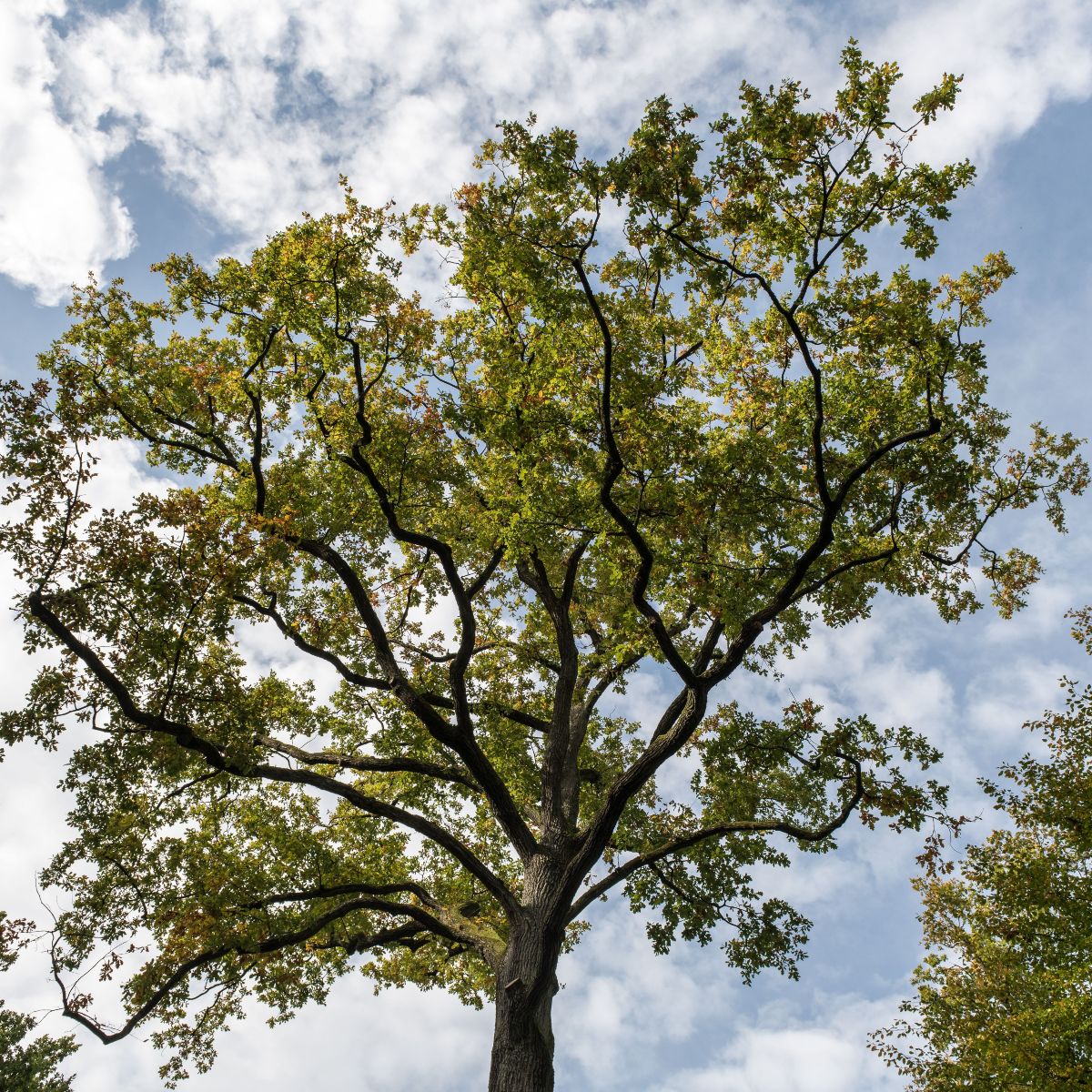
Crown reduction is a professional tree-pruning technique used to reduce a tree’s height and/or spread while retaining its natural structure and functional canopy.
When a mature tree becomes too large for its surroundings, homeowners often look for a way to make it smaller. Maybe branches are approaching the roof, the canopy is extending over a driveway, or the tree’s height has become a concern during storms.
The obvious solution can seem to be cutting the top off.
But tree topping can create serious long-term problems rather than solving the original concern. As we explained in our guide to [Tree Topping], removing large portions of a tree’s canopy can lead to weak regrowth, decay, structural problems, and repeated maintenance.
So what can you do when a tree genuinely needs to be reduced in size?
Crown reduction may provide a safer, more controlled alternative to topping when the tree and site are suitable for the technique. Rather than cutting branches back to arbitrary points, crown reduction selectively shortens branches while retaining an appropriate framework of lateral branches.
The goal isn’t simply to make a tree shorter. It is to manage its height or spread while preserving as much of its natural structure and function as reasonably possible.
Arborist Insight: A tree being “too big” doesn’t automatically mean it needs crown reduction. The right question is whether its size can be managed without unnecessarily compromising its long-term structure and health.
What Is Crown Reduction?
Crown reduction is a professional pruning technique used to decrease a tree’s overall height and/or spread while maintaining a functional, natural-looking canopy.
Instead of removing large sections of the upper canopy, an arborist selectively shortens branches back to suitable lateral branches. These remaining branches can continue the growth pattern of the shortened limbs without leaving large, arbitrary stubs.
Crown reduction may involve a technique commonly known as drop-crotch pruning, where a larger branch is reduced back to a suitable lateral branch that can assume the role of the shortened branch.
The arborist considers the tree’s species, health, existing structure, previous pruning, surroundings, and the amount of reduction actually needed. The objective is to achieve the minimum practical reduction necessary to address the property’s concern while leaving the tree with a functional canopy.
Crown Reduction Is Not the Same as Tree Topping
Both techniques reduce the size of a tree, but the similarity largely ends there.
Tree topping cuts major branches back to arbitrary points or large stubs, removing substantial portions of the canopy and disrupting the tree’s natural structure.
Crown reduction selectively shortens branches back to appropriate lateral branches within the existing framework.
The goal is not to make a tree as small as possible. It is to manage its dimensions while retaining as much of its natural form and structural integrity as reasonably possible.
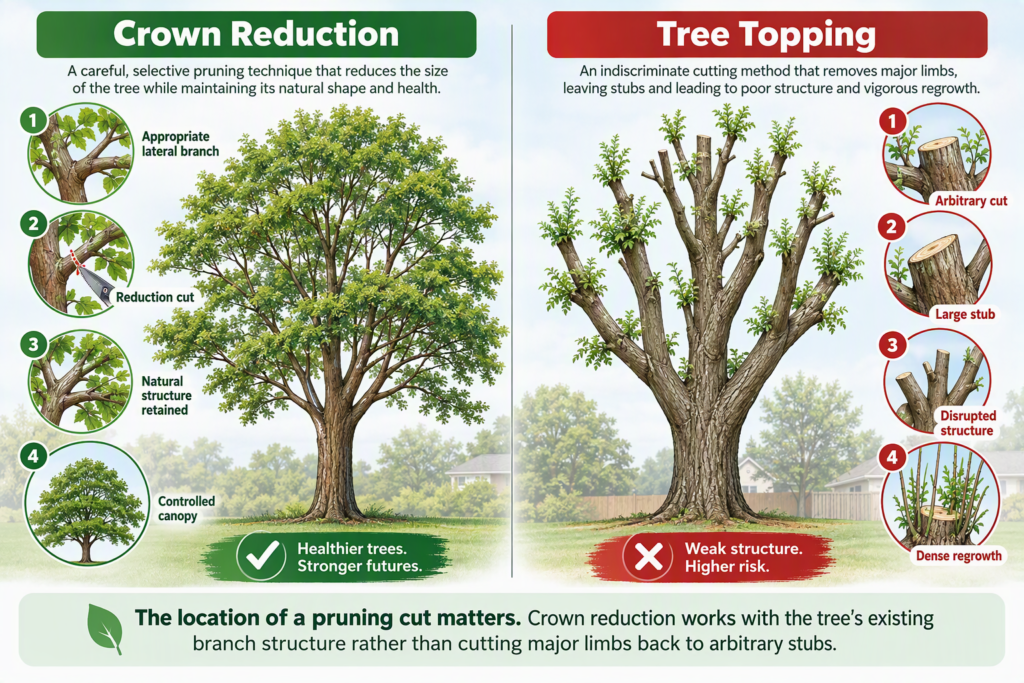
The location of a pruning cut matters. Crown reduction works with the tree’s existing branch structure rather than cutting major limbs back to arbitrary stubs.
How Does Crown Reduction Work?
Crown reduction isn’t simply a matter of deciding how many feet to remove from the top of a tree. An arborist first evaluates the tree and identifies which portions of the canopy can be reduced while maintaining a reasonable structure.
Assessing the Tree and Its Surroundings
The arborist looks at major leaders, branch attachments, overextended limbs, dead or damaged wood, existing decay, and areas of congestion within the canopy.
The surrounding property matters too. A branch extending toward a roof, driveway, walkway, or utility line may require a different approach from one growing safely into open space.
This assessment determines whether reduction can address the homeowner’s concern without creating new problems.
Selecting the Right Reduction Points
Once the branches requiring reduction are identified, the arborist selects appropriate lateral branches where cuts can be made.
The remaining lateral should be appropriately positioned and capable of continuing the branch’s growth pattern.
Arborist Insight: Good crown reduction isn’t about finding the shortest branch to cut. It’s about finding the right branch to leave behind.
Making Proper Pruning Cuts
The location and quality of each cut matter. Branches have natural anatomical structures that help trees respond to pruning wounds.
Where a branch joins a larger limb or trunk, the branch collar forms part of the tree’s natural defense system. Proper pruning respects this structure rather than unnecessarily cutting into it or leaving excessive stubs.
The size and location of each proposed cut also matter. This is why professional crown reduction shouldn’t be treated as a simple “cut X feet off the tree” service.
Maintaining Balance Throughout the Canopy
An arborist doesn’t necessarily remove an identical amount from every branch.
Reduction is performed selectively throughout the canopy to maintain reasonable balance and preserve the tree’s overall appearance and structure.
The finished tree should still look like the same tree—just better suited to its surroundings.
Considering Future Growth
A professional pruning plan also considers what happens after the job.
Branches will continue to grow, so the arborist considers where that growth is likely to develop and whether today’s pruning will create future clearance or structural problems.
Good pruning considers the next stage of the tree’s growth, not just how the tree looks on the day of the job.
When Is Crown Reduction Appropriate?
Crown reduction is generally appropriate when a healthy, structurally suitable tree has outgrown its available space and a reasonable reduction in height or spread can address the concern without excessive canopy removal.
When a Tree Has Outgrown Its Space
A tree that was appropriately sized when planted may eventually grow well beyond the space available to it.
If branches are extending toward a roof, driveway, walkway, or property boundary, crown reduction may help bring the tree’s dimensions back within more manageable limits—provided the desired reduction is reasonable for the tree.
When Clearance Is Becoming a Problem
Branches may eventually grow too close to structures or other areas requiring clearance.
In some cases, only specific portions of the canopy need attention. An arborist can determine whether targeted pruning is sufficient or whether broader reduction is warranted.
When Excessive Height or Spread Is the Main Concern
If a healthy, structurally sound tree has simply become too large, crown reduction may be considered to manage excessive vertical height, lateral spread, or overextended portions of the canopy.
The key is that the desired reduction must be achievable without removing an excessive amount of healthy canopy.
When Crown Reduction May Not Be the Right Solution
Crown reduction isn’t appropriate for every tree.
A different approach may be necessary when:
- The tree is severely declining or already under significant stress.
- Major decay, cracks, weak unions, or other structural defects require specific corrective work.
- The species does not respond well to substantial reduction.
- The tree has already been topped or heavily pruned.
- The homeowner wants the tree reduced far beyond what its structure can reasonably support.
- The tree fundamentally cannot fit its location without repeated drastic pruning.
In these situations, an arborist may recommend selective pruning, crown thinning, structural pruning, ongoing monitoring, or, when a tree is genuinely hazardous and cannot reasonably be retained, removal.
Practitioner Insight
If a tree has to be drastically shortened to fit its location, the problem may not be the tree’s height—it may be the tree’s relationship with the site.
The objective of professional tree care isn’t to force every tree into an artificially small size. It is to determine what management approach makes sense for that tree, on that property, over the long term.
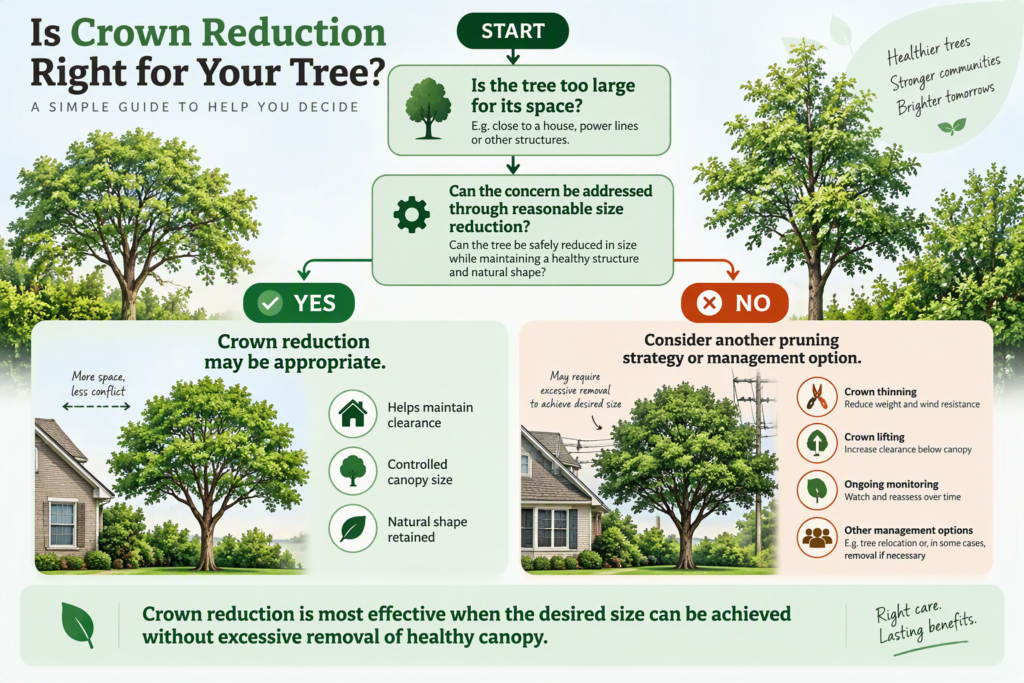
Crown reduction is most effective when the desired size can be achieved without excessive removal of healthy canopy.
Crown Reduction vs. Crown Thinning
Crown reduction and crown thinning are both professional pruning techniques, but they address different concerns.
| Crown Reduction | Crown Thinning | |
|---|---|---|
| Primary goal | Reduce height and/or spread | Reduce excessive canopy density |
| Main concern | Tree is too large for its space | Canopy is too dense or crowded |
| Overall size | Decreases | Generally remains similar |
| Pruning approach | Selectively shortens branches | Selectively removes branches throughout the canopy |
| Typical result | Smaller, manageable canopy | More open, balanced canopy |
A simple way to think about the difference:
If the problem is “My tree is too large,” crown reduction may be appropriate.
If the problem is “My tree is too dense,” crown thinning may be more appropriate.
In some cases, an arborist may recommend one technique or a combination of pruning approaches depending on the tree and the property’s needs.
Not sure which type of pruning your tree needs? A professional assessment can help determine whether reduction, thinning, structural pruning, or another approach is appropriate.
Learn more in our upcoming guide to Crown Thinning.
How Much Can a Tree Be Reduced?
There isn’t a universal percentage or number of feet that should be removed during crown reduction.
The appropriate amount depends on the tree’s species, health, structure, size, previous pruning, and the reason for the work.
A healthy, established tree may respond differently to pruning than a tree already stressed by disease, drought, root problems, or previous topping.
The desired result matters too. Reducing a tree slightly to manage its spread is very different from trying to make a large mature tree dramatically shorter.
More Reduction Isn't Always Better
The goal should be the minimum practical reduction needed to address the concern, rather than removing as much canopy as possible.
If achieving the desired size requires removing an excessive amount of healthy growth, crown reduction may not be the right solution.
That’s why a professional arborist should evaluate the tree before recommending how much to remove rather than promising a fixed percentage for every tree.
What Happens After Crown Reduction?
Crown reduction doesn’t permanently stop a tree from growing. The tree will continue producing new foliage and branches, and the canopy will gradually expand again.
Immediately after pruning, the tree may look somewhat more open than it did before the work. Over time, new growth fills portions of the canopy.
How quickly the tree grows back depends on its species, health, growing conditions, and the amount of pruning performed.
For some trees, periodic maintenance may eventually be appropriate. Regular monitoring can also help address developing clearance or structural concerns before they require a more significant intervention.
The objective isn’t to stop the tree from growing. It’s to manage that growth responsibly over time.
Frequently Asked Questions About Crown Reduction
Not necessarily. When appropriate for the tree and performed correctly, crown reduction can be an effective way to manage excessive height or spread. Problems generally arise when too much canopy is removed or pruning is performed without considering the tree’s structure and condition.
No. Crown reduction reduces the tree’s current size but does not stop future growth. The tree will continue to produce new foliage and branches.
It can address certain clearance or structural concerns, but simply making a tree smaller does not automatically make it safer. Risk also depends on factors such as decay, defects, branch attachments, root conditions, species, and surrounding targets.
No. Tree trimming or pruning is a broad term covering many different pruning objectives. Crown reduction is a specific technique intended to reduce a tree’s overall height and/or spread.
No. Species, health, structure, location, previous pruning, and the desired amount of reduction all need to be considered. Some trees may be better suited to another pruning strategy.
There is no universal schedule. Growth rate, species, site conditions, and the reason for the original pruning all influence how frequently a tree may require maintenance.
Need Help Deciding What Your Tree Needs?
When a tree becomes too large for its surroundings, topping isn’t the only option—and it may be one of the worst.
Crown reduction can provide a more controlled way to manage tree height or spread when the technique is appropriate. But the right pruning strategy depends on the individual tree, its condition, and the property around it.
JC Tree Service can assess your tree and recommend the appropriate approach—whether that’s crown reduction, crown thinning, another pruning technique, or no major pruning at all.
Our goal is simple: help you manage your trees safely while protecting their long-term value and structural integrity.