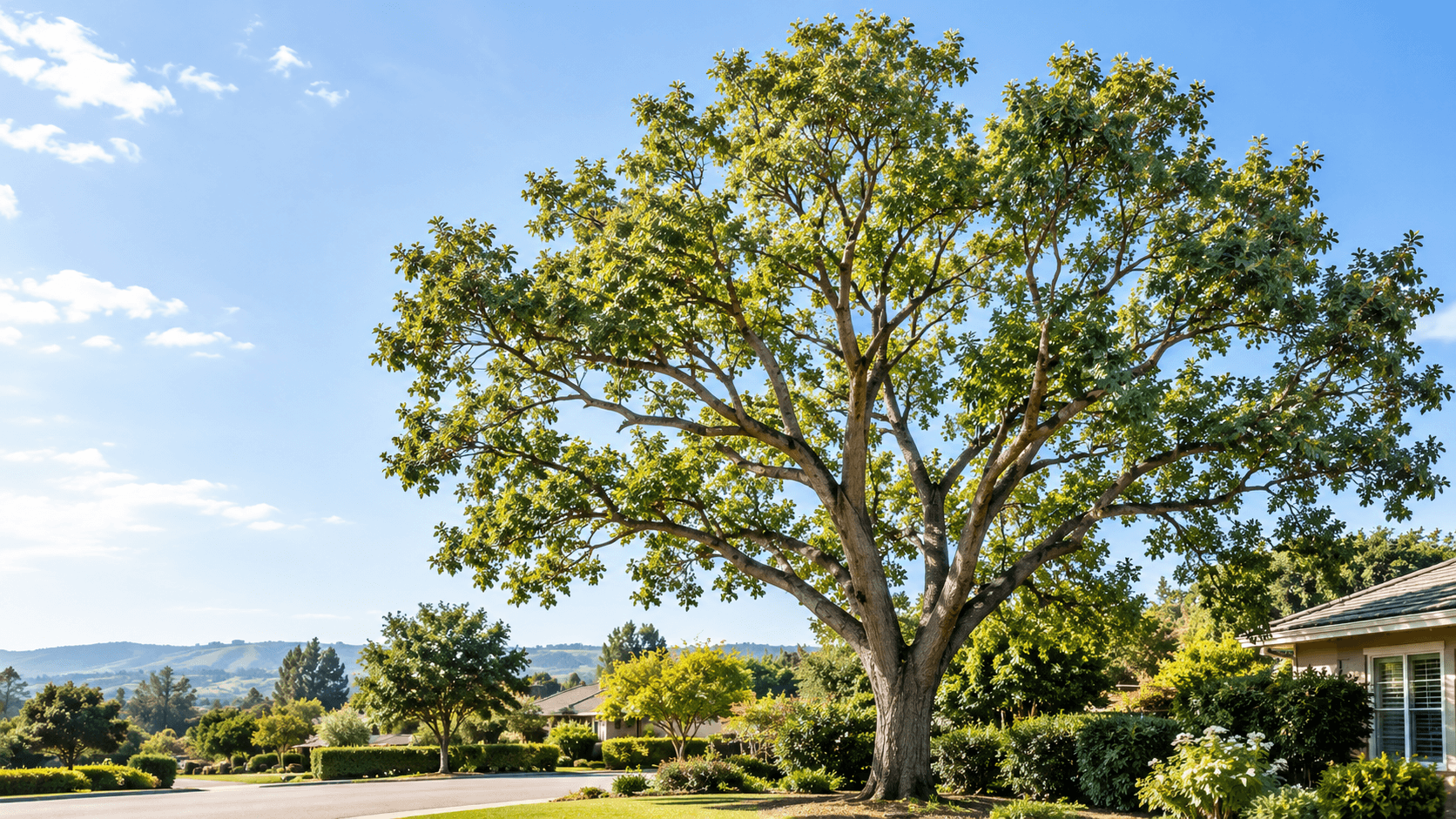
A tree doesn’t have to be too tall or too wide to create a pruning concern. Sometimes the problem is simply density.
As mature trees grow, branches can become crowded, overlap, cross, or compete for space. A dense canopy may also block desired views or create localized clearance concerns.
The instinct may be to remove large portions of the tree. But if the tree’s overall size is appropriate, making it smaller isn’t necessarily the answer.
Crown thinning can help manage excessive canopy density while preserving much of the tree’s overall height, spread, and natural form.
Unlike tree topping, which removes major portions of the canopy, or crown reduction, which is primarily used to decrease a tree’s overall dimensions, crown thinning involves the selective removal of appropriate branches throughout the canopy.
The objective isn’t to strip the tree open or remove as many branches as possible. It’s to create a more evenly distributed canopy while retaining enough healthy foliage and structural branches for the tree to continue developing normally.
Arborist Insight: A dense tree isn’t automatically an unhealthy or hazardous tree. Before removing branches, an arborist should determine whether the density is actually creating a problem—and whether thinning is the appropriate solution.
What Is Crown Thinning?
Crown thinning is a pruning technique that selectively removes branches throughout a tree’s canopy to reduce excessive density and improve the distribution of remaining branches and foliage.
Unlike crown reduction, the primary objective is not to make the tree shorter or smaller.
Instead, an arborist selectively removes certain branches while leaving the overall dimensions of the canopy largely intact.
Crown thinning may address:
- Crowded or overlapping branches
- Poorly distributed growth
- Selected branches that are rubbing or competing
- Excessive density in specific areas
- Branches that can be removed without compromising the tree’s overall structure
The arborist works throughout the canopy rather than simply cutting the outer ends of branches. The goal is to maintain a natural appearance while improving the distribution of foliage.
The Goal Isn't to Make the Tree "See-Through"
One common misconception is that a properly thinned tree should allow you to see clearly through the entire canopy.
That’s not the objective.
Trees need foliage to produce energy through photosynthesis. Removing too many branches can reduce the tree’s ability to support itself and may encourage undesirable growth.
Good crown thinning creates space within the canopy without stripping the tree of the foliage it needs.
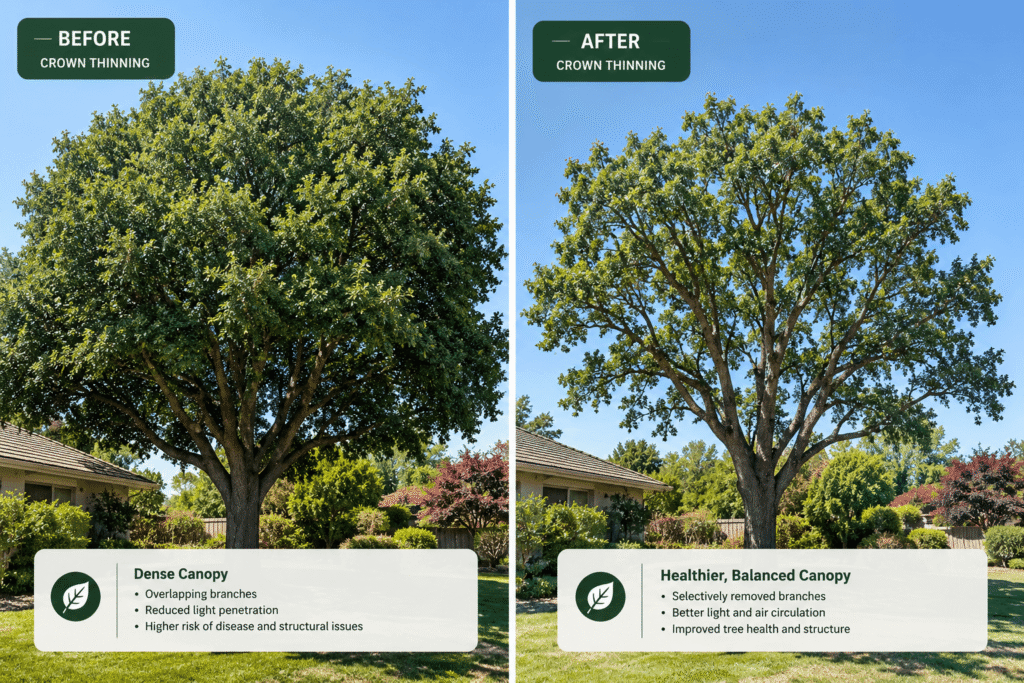
Crown thinning selectively reduces canopy density while maintaining the tree’s overall height, spread, and natural form.
Crown Thinning vs. Crown Reduction
Crown thinning and crown reduction are often confused because both involve selective pruning. However, they address different problems.
Too large? Think crown reduction. Too dense? Think crown thinning.
| Crown Thinning | Crown Reduction | |
|---|---|---|
| Primary goal | Reduce canopy density | Reduce tree height and/or spread |
| Main concern | Crowded or overly dense canopy | Tree has outgrown its space |
| Overall height | Generally remains similar | Decreases |
| Overall spread | Generally remains similar | Decreases |
| Pruning approach | Selective branch removal throughout the canopy | Selective shortening of branches |
| Typical result | More evenly distributed canopy | Smaller, more manageable canopy |
If the tree’s overall size is appropriate but certain portions have become crowded, crown thinning may be considered.
If the primary concern is that the tree has become too tall or too wide for its surroundings, crown reduction may be more appropriate.
The distinction matters because using the wrong technique may fail to address the homeowner’s actual concern. Trying to make a very large tree smaller through thinning, for example, doesn’t solve the problem of excessive height or spread.
Arborist Insight: Pruning should begin with the problem you’re trying to solve—not with a particular pruning technique you’ve heard about.
When Is Crown Thinning Appropriate?
Crown thinning can be appropriate when a tree’s overall size is acceptable but its canopy has become excessively crowded or unevenly distributed.
The decision should be based on the tree’s condition and the specific concern—not simply on how dense the canopy looks from the ground.
When Branches Are Crowded or Overlapping
As trees mature, branches can grow into one another and compete for space. Some may cross or rub against neighboring branches, while others create dense clusters within the canopy.
Selective thinning can address appropriate branches within these crowded areas while leaving the rest of the canopy intact.
When Growth Is Unevenly Distributed
Changes in sunlight, surrounding vegetation, previous pruning, and site conditions can cause certain portions of a canopy to become significantly denser than others.
An arborist can selectively remove branches from crowded areas to create a more balanced distribution of foliage.
When You Want to Improve Visibility Through Portions of the Canopy
A homeowner may want to open a limited portion of the canopy around a driveway, walkway, window, or particular view.
Selective thinning may help accomplish this without substantially reducing the tree’s overall size.
However, visibility alone shouldn’t justify removing large amounts of healthy foliage.
When Specific Branches Are Poorly Positioned
Not every pruning job needs to involve the entire canopy.
If only certain branches are poorly positioned, damaged, crowded, or competing with better-placed growth, selective removal may address the concern without significantly changing the tree’s overall appearance.
The advantage of a targeted approach is that the arborist can remove specific problem branches rather than treating the entire canopy as a problem.
When Crown Thinning May Not Be the Right Solution
Crown thinning isn’t a universal way to make a tree safer or healthier.
It may not be appropriate when:
- The tree is simply too large: Thinning generally does not significantly reduce overall height or spread. Crown reduction or another approach may be more appropriate.
- The tree is already sparse or declining: Removing additional healthy foliage may place unnecessary stress on a tree that is already struggling.
- The main problem is structural: Significant decay, cracks, weak unions, or other defects may require specific corrective work rather than general thinning.
- The goal is to dramatically open the canopy: Removing large amounts of foliage simply to make a tree look “airy” can cause unnecessary stress.
- The requested pruning is excessive: If the desired result requires removing a substantial portion of the canopy, the arborist should reassess whether thinning is appropriate at all.
Arborist Insight: More open doesn’t necessarily mean healthier or safer. A tree needs sufficient foliage to produce energy, and its branches provide the structure that supports the canopy. Good thinning removes what is appropriate—not everything that looks crowded.
How Does Crown Thinning Work?
Professional crown thinning is a selective process, not a matter of randomly removing branches until the canopy looks more open.
An arborist generally works through four stages:
1. Assess
The tree is evaluated from different viewpoints to understand how branches and foliage are distributed.
The arborist looks for crowded areas, crossing or rubbing branches, damaged growth, structural concerns, and other factors that may influence the pruning plan.
2. Select
Individual branches are identified for removal based on their position, condition, and contribution to the overall canopy.
The goal is selective removal, not uniform removal from every part of the tree.
3. Distribute
Pruning is distributed throughout the canopy as appropriate rather than concentrating excessive removal in one area.
This helps maintain a balanced appearance and avoids unnecessarily disrupting the tree’s structure.
4. Reassess
After selected branches are removed, the arborist evaluates the canopy again.
This helps prevent over-thinning, where the goal becomes making the tree look as open as possible rather than addressing the original concern.
The goal of crown thinning isn’t to remove a certain number of branches. It’s to achieve the appropriate reduction in canopy density while retaining a healthy, balanced tree.
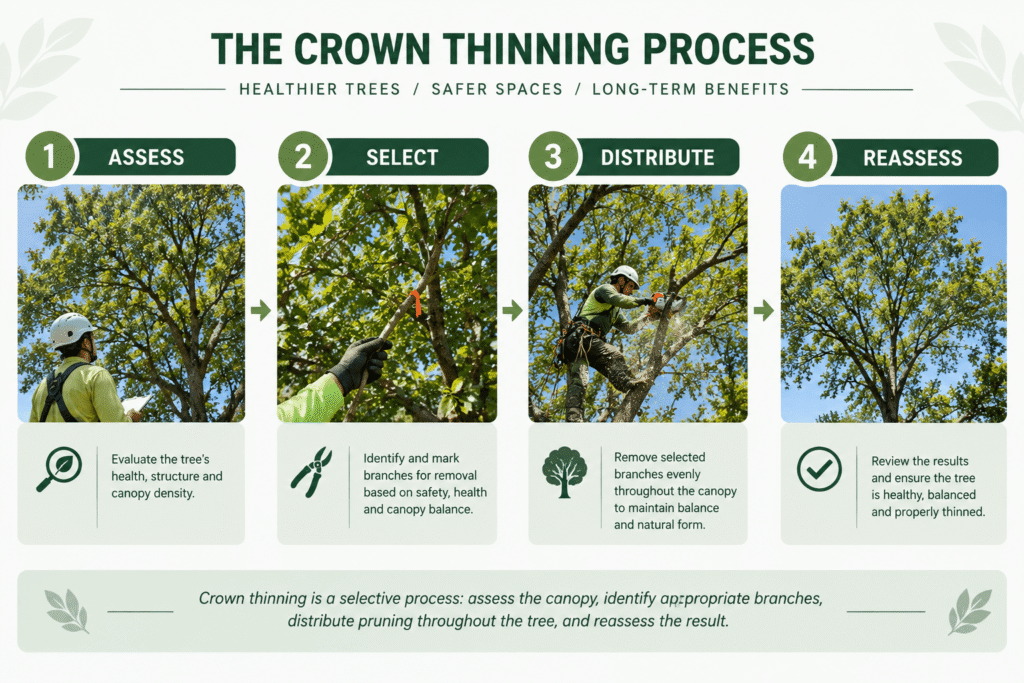
Crown thinning is a selective process: assess the canopy, identify appropriate branches, distribute pruning throughout the tree, and reassess the result.
Benefits of Crown Thinning
When crown thinning is appropriate and performed selectively, it can help manage a crowded canopy without substantially changing the tree’s overall dimensions.
Maintains Overall Tree Size
Unlike crown reduction, thinning generally doesn’t aim to make the tree shorter or narrower. The tree can retain much of its established height and spread.
Reduces Canopy Crowding
Selective branch removal can improve the distribution of foliage where growth has become overly concentrated.
Addresses Branch Competition
When branches overlap, cross, or compete for the same space, selective removal can help reduce unnecessary crowding.
Preserves Natural Appearance
Because thinning is performed selectively throughout the canopy, the objective is to maintain the tree’s natural form rather than create a flat or artificially sparse appearance.
Can Address Specific Visibility Concerns
In appropriate situations, selective thinning can open limited portions of the canopy around a driveway, walkway, window, or view without substantially reducing the tree’s overall size.
How Much Should a Tree Be Thinned?
There is no single percentage that applies to every tree.
The appropriate amount depends on the species, canopy density, health, structure, growing conditions, and previous pruning history.
A tree that is already stressed or sparse may require little or no thinning, while a healthy tree with significant localized crowding may tolerate more selective removal.
For that reason, professional thinning should not be based on a predetermined promise such as “We’ll remove 20% of the tree.” The arborist should evaluate the canopy and determine which branches can reasonably be removed.
More thinning does not mean better thinning.
Removing excessive foliage can leave a tree unnecessarily stressed and may encourage undesirable regrowth. The goal is to remove enough to address the specific concern—without removing more than necessary.
What Happens After Crown Thinning?
Crown thinning doesn’t stop a tree from growing.
The tree will continue producing new foliage and branches, gradually filling some of the space created by pruning. How quickly this happens depends on the species, health, growing conditions, and growth rate.
Immediately after pruning, the canopy may look somewhat more open. Over time, new growth develops and the tree’s appearance becomes more natural again.
The objective isn’t for the tree to remain permanently sparse.
The goal is to create a better-distributed canopy that can continue developing naturally.
Future maintenance may eventually be appropriate, particularly for fast-growing trees or trees with recurring clearance concerns. However, pruning should be based on the tree’s growth and condition—not an arbitrary schedule.
Frequently Asked Questions About Crown Thinning
It can address certain branch-crowding or clearance concerns, but thinning should not be presented as a guarantee against storm damage or tree failure.
Overall tree risk depends on factors including structural defects, decay, branch attachments, roots, species, site conditions, and nearby targets.
Generally, no. Crown thinning is primarily intended to reduce canopy density, while overall height and spread remain relatively similar.
If the main concern is excessive height or spread, crown reduction may be more appropriate.
There is no universal schedule. Future pruning depends on the tree’s species, growth rate, condition, site, and how the canopy develops after the initial work.
No. Some trees may be too stressed, sparse, structurally compromised, or otherwise unsuitable for additional canopy removal. A professional assessment should come before significant pruning.
Improper or excessive thinning can. Removing too much healthy foliage can reduce the tree’s ability to produce energy and may encourage undesirable growth.
That’s why professional thinning focuses on selective removal rather than maximum removal.
Neither technique is universally better. They solve different problems.
If the tree is too large, crown reduction may be appropriate. If the tree is appropriately sized but excessively dense, crown thinning may be the better fit.
Not Sure Which Pruning Approach Your Tree Needs?
A dense canopy doesn’t necessarily mean a tree needs to be heavily pruned. Likewise, a large tree doesn’t automatically need to be reduced.
The right approach depends on what is actually happening with the tree.
JC Tree Service can evaluate your tree’s structure, health, canopy density, surroundings, and pruning history to determine whether crown thinning, crown reduction, another pruning strategy, or no major pruning is appropriate.
Our goal is not to remove as much as possible. It’s to perform the right work for the tree and the property.