A tree may look healthy on the outside while developing structural weaknesses that become more difficult to address as it grows. Competing stems, weak branch attachments, and crowded branches can affect how a tree develops over time.
Structural pruning is a selective tree-care practice that helps guide a tree’s growth toward a suitable, well-developed branch structure. By addressing certain structural concerns early, property owners can help reduce the need for extensive corrective pruning later.
Understanding how structural pruning works can help homeowners recognize potential problems and make informed decisions about long-term tree care.
What Is Structural Pruning?
Structural pruning involves selectively removing or reducing branches to influence how a tree’s trunk and branches develop. Unlike routine trimming, which may focus on appearance, clearance, or removing dead branches, structural pruning focuses on the arrangement and development of the tree’s framework.
Depending on the species and existing structure, this may involve:
- Encouraging a dominant central leader in species that naturally develop one.
- Managing competing leaders that may form weak unions.
- Improving branch spacing and reducing conflicts between branches.
- Addressing selected branches with potentially weak attachments.
- Maintaining a suitable framework while preserving the tree’s natural shape.
Structural pruning is especially useful during a tree’s early development, when smaller branches can often be managed with less extensive cuts. However, not every tree needs a central leader, and the appropriate approach depends on its natural growth habit.
Common Structural Problems in Trees
Structural concerns can develop gradually as branches grow and compete for space. Recognizing these patterns can help property owners understand when professional assessment may be appropriate.
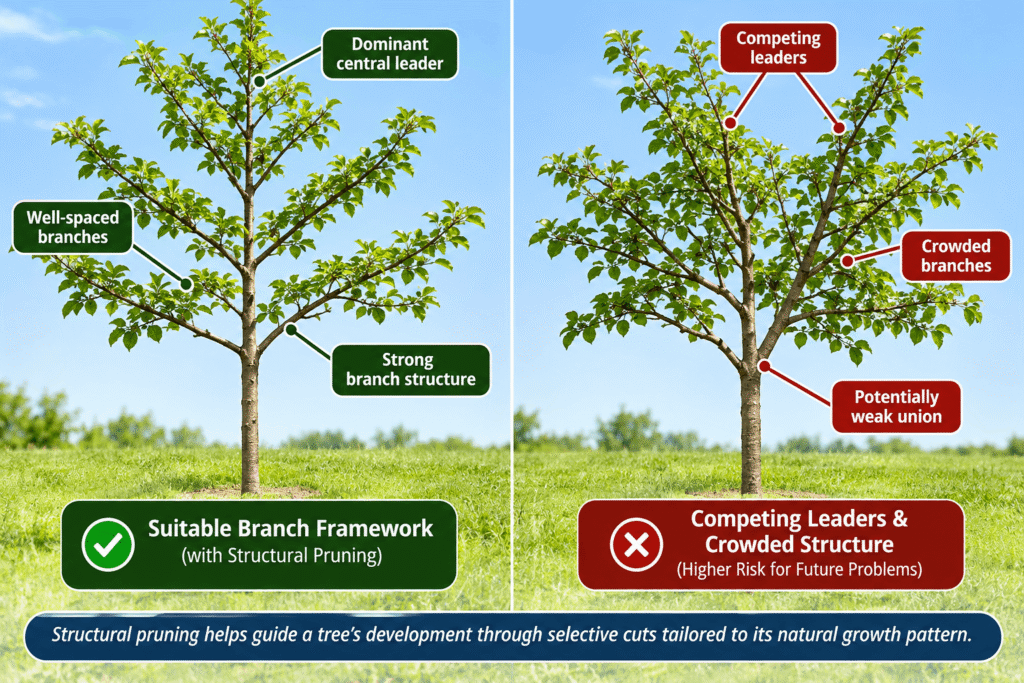
1. Competing Leaders
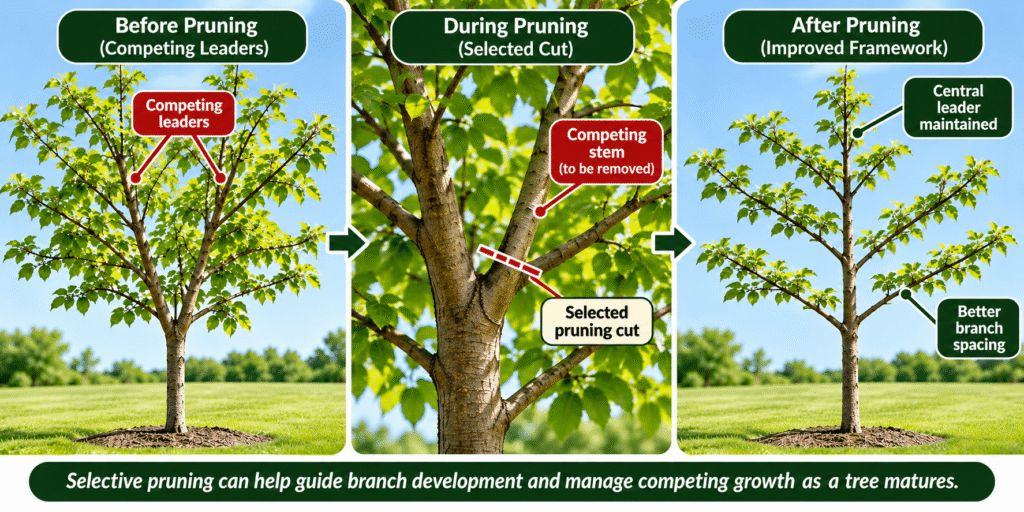
A leader is the main upright stem that forms a tree’s primary axis of growth. In species that naturally develop a central leader, two or more similarly dominant stems may compete for that role.
Closely attached competing stems can form unions that are more vulnerable to splitting under certain conditions. Selective pruning may help establish a more suitable leader while the tree is young.
2. Included Bark
Included bark develops when bark becomes trapped between adjoining stems or branches. This can prevent a strong wood connection from forming and may increase the potential for the union to split.
Not every narrow branch union contains included bark, so assessment should consider the actual attachment and the tree’s overall condition.
3. Weak Branch Attachments
Some branches have attachments affected by included bark, damage, or unfavorable growth patterns. As branches become larger and heavier, these concerns may become more consequential.
An arborist can assess whether selective removal, branch reduction, or monitoring is appropriate.
4. Poorly Spaced or Overcrowded Branches
Branches that grow too close together may cross, rub against one another, or compete for growing space. Selective pruning can help manage these conflicts while retaining branches that contribute to the tree’s development.
Why early assessment matters: Some structural concerns are easier to manage while branches are small. As trees mature, corrective work may involve larger cuts, and certain established defects cannot be fully corrected through pruning alone.
How Structural Pruning Helps Prevent Future Tree Problems
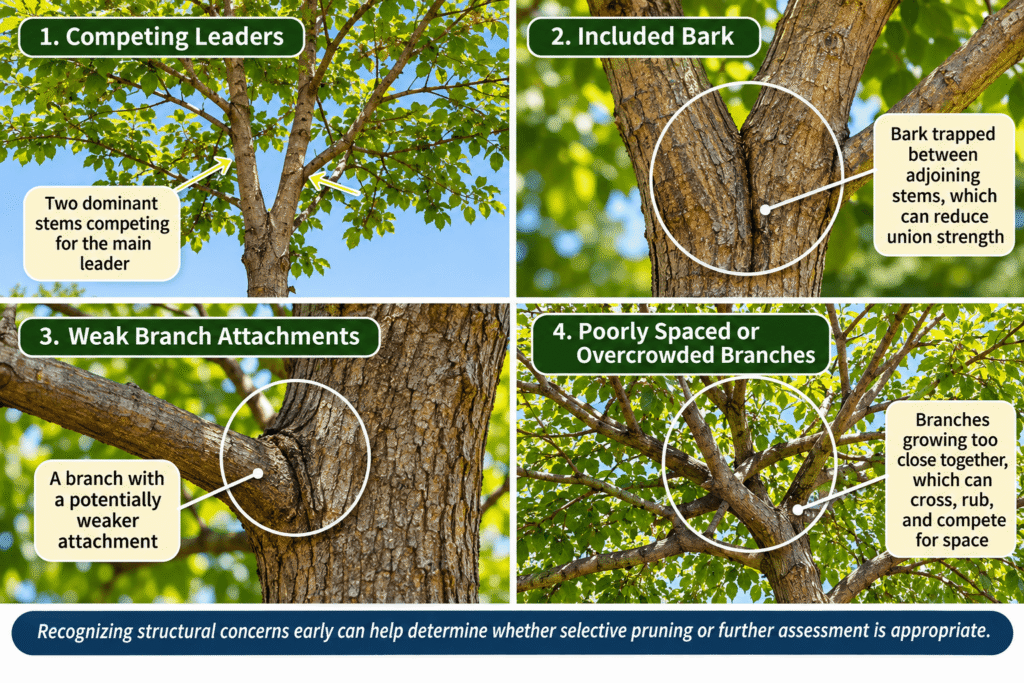
Structural pruning guides tree development through carefully selected cuts. The objective is not to remove as much growth as possible, but to address specific concerns while preserving appropriate branches and the tree’s natural form.
Encouraging a Suitable Central Leader
For species that naturally develop a central leader, selective pruning can help maintain one dominant upright stem. Managing a competing stem early may reduce the likelihood of developing large, closely attached leaders.
Improving Branch Spacing
Selective pruning can help manage branches that compete for the same space or create an overcrowded framework. The goal is to maintain a suitable distribution of branches rather than create an artificially symmetrical canopy.
Managing Potentially Weak Attachments
When an arborist identifies a concerning branch attachment, selective pruning may help manage the issue. Depending on the situation, this may involve removing a smaller competing stem, reducing a branch to an appropriate lateral branch, or monitoring the attachment.
Not every structural defect can be corrected through pruning, particularly when large stems or established weaknesses are involved.
Reducing the Need for Extensive Corrective Cuts
Early pruning can address selected concerns before branches become substantially larger. Smaller, properly placed cuts are generally easier for a tree to compartmentalize than large cuts, although outcomes depend on the species, tree health, and quality of the work.
Structural pruning cannot eliminate every risk of branch failure. Its value lies in guiding development and managing identifiable concerns over time.
When Should a Tree Be Structurally Pruned?
Structural pruning is often most beneficial while a tree is young, but the appropriate timing depends on its species, condition, growth rate, and structural needs.
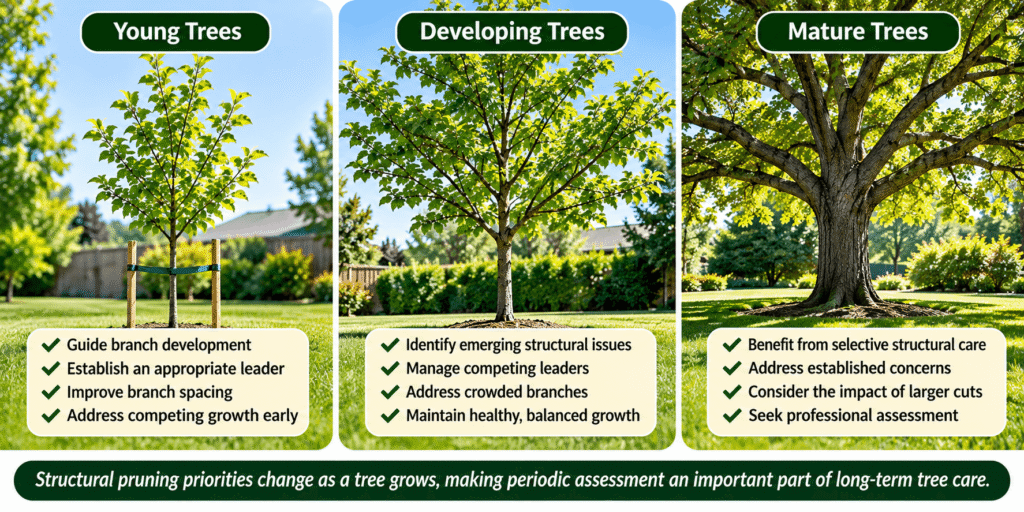
Young Trees
Young trees offer an opportunity to guide branch development before structural concerns become more difficult to manage. Selective pruning may help establish an appropriate leader, improve spacing, and address competing growth while branches are small.
Developing Trees
As trees grow, periodic assessments can identify emerging problems, including competing leaders and crowded branches. Pruning should focus on the most important structural priorities while retaining sufficient foliage for healthy growth.
Mature Trees
Mature trees can benefit from selective structural management, but established concerns may be more complicated to address. Large corrective cuts can create substantial wounds or alter the tree’s structure, so professional assessment is especially important.
Does the Time of Year Matter?
Pruning timing depends on the species, the purpose of the work, and the tree’s condition. Some structural pruning can be performed during dormancy, while other circumstances may call for a different time. Dead, damaged, or hazardous branches may require prompt attention regardless of the usual pruning season.
Can Structural Pruning Be Done on Mature Trees?
Yes. Mature trees may benefit from structural pruning, although the available options can be more limited than they are for young trees.
As branches and stems become larger, correcting a structural concern may require substantial cuts. An arborist may recommend selectively reducing a branch, managing a competing stem, monitoring an attachment, or considering another risk-management approach.
The best option depends on the tree’s species, condition, branch size, and the nature of the concern. Some established defects cannot be fully corrected through pruning.
The goal is to manage identifiable structural concerns while preserving appropriate branches and the tree’s natural form, rather than making extensive cuts simply to reshape the canopy.
When to Call a Professional Arborist
Consider contacting a qualified arborist if you notice:
- Two large stems growing closely together from the same point.
- Visible cracks or splitting around a major branch union.
- Persistent branch rubbing or damaged bark.
- Large branches with signs of damage or potentially weak attachments.
- Hanging limbs, broken branches, or sudden changes in the tree’s structure.
These signs do not all indicate the same level of risk. A professional can assess the tree’s condition, branch attachments, and surroundings before recommending an appropriate course of action.
If a tree has a major crack, a hanging limb, or signs of recent structural failure, keep people away from the affected area and arrange a prompt assessment. Avoid climbing the tree or attempting to remove large branches yourself.
Structural Pruning for Trees in Contra Costa County
Trees throughout Contra Costa County provide shade, privacy, and character to residential and commercial properties. From newly planted landscape trees to established shade trees, appropriate structural care can help support long-term development.
Local growing conditions, tree species, available space, and exposure to wind can influence how trees develop. Trees near homes, driveways, and walkways may also require different management considerations from those growing in open landscapes.
Homeowners in Walnut Creek, Lafayette, Danville, Alamo, San Ramon, and Pleasant Hill can benefit from periodic tree assessments that identify developing concerns and help guide maintenance decisions.
The appropriate pruning approach depends on the individual tree, including its species, health, structure, and surroundings. Young trees may benefit from early structural guidance, while mature trees may require selective management of established concerns.
JC Tree Service helps homeowners and property managers understand their tree-care needs and determine when professional pruning or further assessment may be beneficial.
Protect Your Trees With Professional Pruning
Structural pruning is an important part of long-term tree care. By addressing selected structural concerns while branches are still relatively small, property owners can help guide tree development and reduce the need for some extensive corrective work later.
Whether you have a newly planted landscape tree or an established shade tree with competing stems or crowded branches, understanding its structure is an important first step.
JC Tree Service helps homeowners and property managers throughout Contra Costa County assess their tree-care needs and determine when professional pruning may be beneficial.
Have questions about your trees? Contact JC Tree Service to discuss your tree’s condition and explore appropriate care for your property.
Frequently Asked Questions
Structural pruning guides a tree’s branch development to establish a suitable framework. It can help manage competing leaders, improve branch spacing, and address certain structural concerns.
Structural pruning often begins when a young tree has developed enough growth for its branch structure to be assessed. Timing depends on the species, condition, and developing structure.
Structural pruning focuses on developing or maintaining a tree’s branch framework. Routine trimming may address clearance, appearance, dead branches, or general maintenance needs.
Competing leaders are two or more stems growing upward with similar dominance. In species that naturally develop a central leader, these stems may form a potentially weak union.
Yes. Included bark can weaken the connection between adjoining stems and increase the potential for splitting. The actual risk depends on the union’s structure and other factors.
Yes. Mature trees may benefit from selective structural management, but established defects and large stems require careful assessment before corrective work is recommended.
There is no universal schedule. Young trees should be assessed periodically as they grow, with pruning performed when specific structural needs are identified.