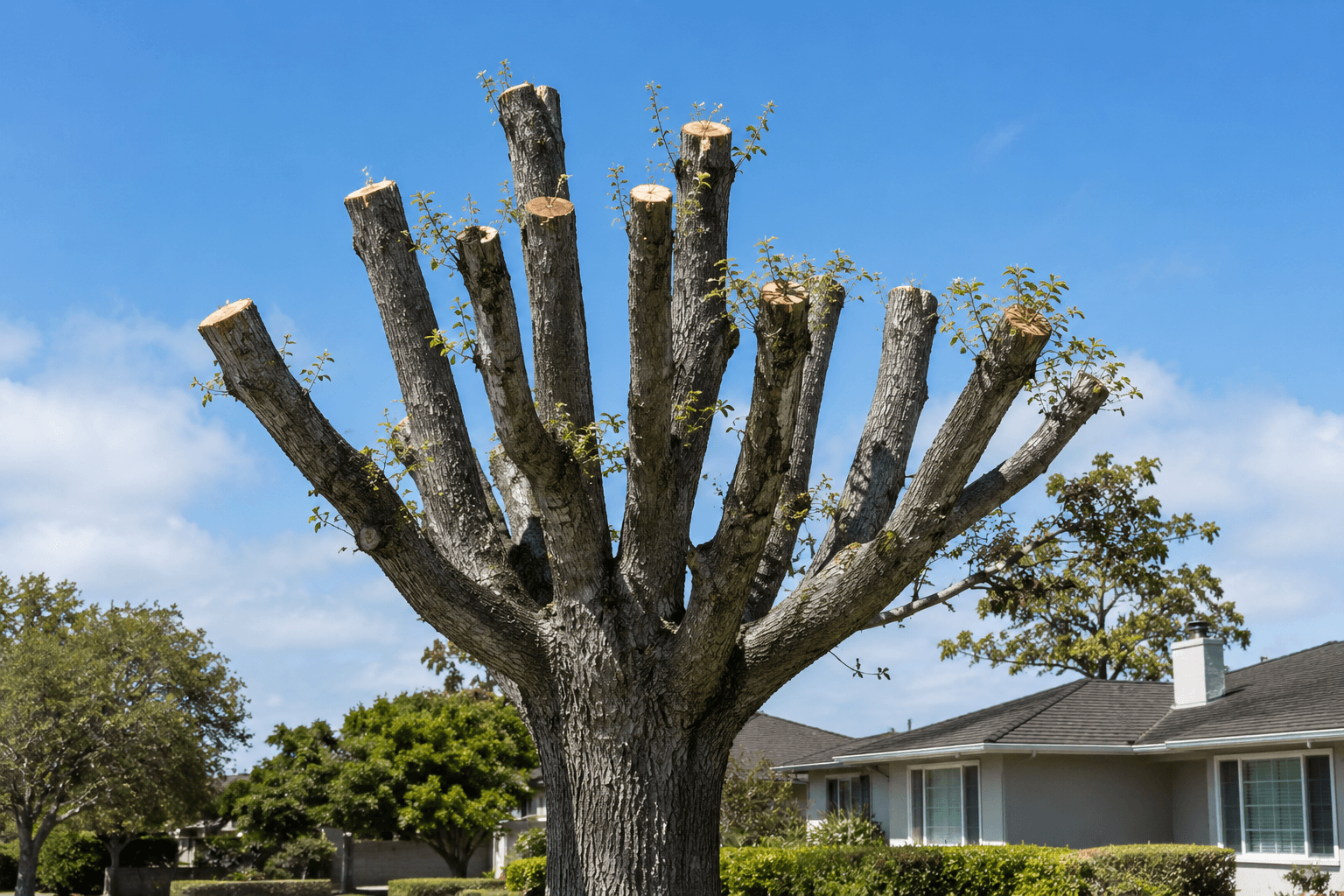
When a massive tree looms over your roof or driveway, it’s natural to feel anxious during a storm. The most common instinct? “If we just chop the top half off, it can’t crush the house.”
It seems like common sense. Unfortunately, this practice, known as “topping,” “heading,” or “hat-racking“, does the exact opposite. It doesn’t make the tree safer; it practically guarantees future property damage.
At JC Tree Service, we avoid topping trees except in specific circumstances where it is the only viable option. Topping is widely recognized by professional arborists as a damaging pruning practice in arboriculture. Here is the reality of what happens when you cut the top off a tree, and why it will cost you far more in the long run.
Key Takeaways:
- It starves the tree: Removing the leafy canopy cuts off the tree’s food supply.
- It causes severe rot: Flat stub cuts cannot heal, inviting pests and deep decay.
- It creates fall hazards: The rapid regrowth (water sprouts) is weakly attached and prone to breaking during storms.
- It voids insurance: Many policies deny claims for damage caused by topped trees due to “negligent maintenance.”
1.Why Does Tree Topping Harm a Tree's Health?
To understand why topping is so destructive, you have to look at how a tree feeds itself. A tree’s leaves are its food factories, producing the energy required for the tree to grow, heal, and defend against disease.
When a tree is topped, it suddenly loses 50% to 100% of its leaf-bearing crown. This throws the tree into photosynthetic shock. It is literally starving.
To survive, the tree enters a panic response. It taps into its emergency energy reserves to rapidly push out new foliage. These new branches are called epicormic shoots (often referred to as “water sprouts”).
When you top a tree, you turn one branch into hundreds of little branches that are then fighting for space.
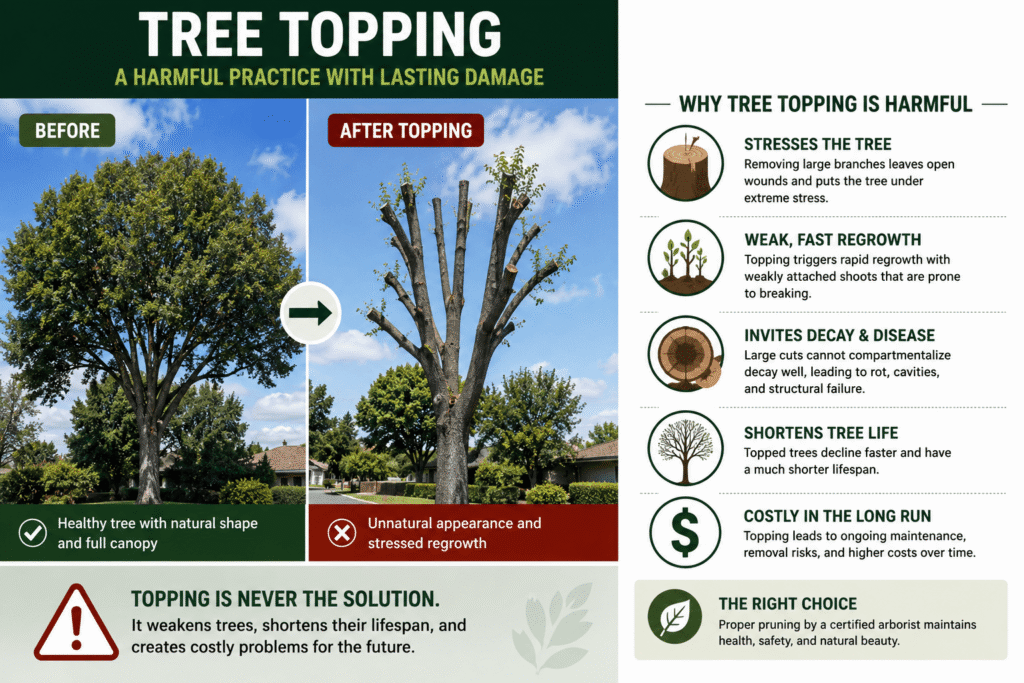
Starved trees panic and push out dense clusters of weak epicormic shoots just to survive
Instead of a majestic, natural canopy, your tree now sprouts thin, dense clusters of twigs that look like a witch’s broom. And if an older tree lacks the stored energy to push out these emergency shoots? It simply dies.
2. How Does Tree Topping Weaken Branches?
The unsightliness of a topped tree is bad, but the structural danger is much worse. Topping creates a ticking time bomb hanging over your property.
Here is exactly why those branches eventually fall:
- Bypassing the Branch Collar: Where a branch naturally meets the trunk, there is a swollen area called the branch collar. This area contains specialized cells that allow the tree to heal over a cut. Topping ignores this anatomy, slicing right through the middle of branches (internodes) where the tree has no ability to close the wound.
- An Invitation for Decay: Because the massive stub wounds stay permanently open, wood-rotting fungi and insects easily enter the tree. The stubs begin to hollow out and rot from the top down.
- The “Weak Attachment” Hazard: Those rapidly growing water sprouts don’t grow from the strong, deep, interweaving wood of the trunk like natural branches do. They sprout from the shallow outer layers right under the bark.
The Eye-Opener: Fast forward 3 to 5 years. You now have dense, heavy, 20-foot branches anchored to rotting, decaying stubs. This is exactly when they snap and fall on cars, power lines, and roofs during a storm.
Tree Topping vs. Proper Pruning: Long-Term Costs and Risks
| Action | Year 1 Cost | 10-Year Maintenance | Risk of Property Damage | Long-Term Result |
|---|---|---|---|---|
| Tree Topping | Lower initial quote | High (needs trimming every 1–2 years) | Extremely High (weak branch attachment) | Declining tree; potentially expensive removal |
| Proper Pruning* | Standard professional rate | Lower (maintains natural structure) | Lower when properly managed | Healthier, structurally sound tree |
*Proper pruning is generally the better choice because the goal should be to manage a tree’s growth and structure without unnecessarily reducing its height.
3. How Much Does Tree Topping Cost in the Long Run?
Many homeowners choose tree topping because the initial quote from an uncertified “tree guy” seems cheap. In reality, topping is the most expensive mistake you can make with your landscape.
- The Maintenance Trap: Because epicormic shoots grow back so rapidly and densely, you will be forced to pay a crew to come out and trim the tree every few years just to keep the dense brush under control.
- The Removal Inevitability: Eventually, the rot wins. Removing a massive, dead, structurally compromised tree is significantly more dangerous, and therefore much more expensive, than properly pruning a healthy one.
- The Insurance Nightmare: If one of those weakly attached branches falls on your house, don’t assume insurance will cover it. Many homeowner insurance policies will deny a claim if the adjuster determines the tree fell due to “negligent maintenance” (and tree topping is documented negligence). Some insurers may even drop your coverage entirely if they identify topped, hazardous trees on your property during an inspection.
3 Red Flags of a "Hack" Tree Service
Before you sign a quote, make sure you aren’t hiring someone who will butcher your landscape. Walk away if a contractor:
- Advertises “Topping” or “Hat-Racking” or Doesn’t Push Back: A qualified tree professional should explain why topping is harmful and recommend a proper pruning alternative rather than simply agreeing to top the tree because that’s what the homeowner requested.
- Lacks Credentials: Ask for their ISA (International Society of Arboriculture) certification number.
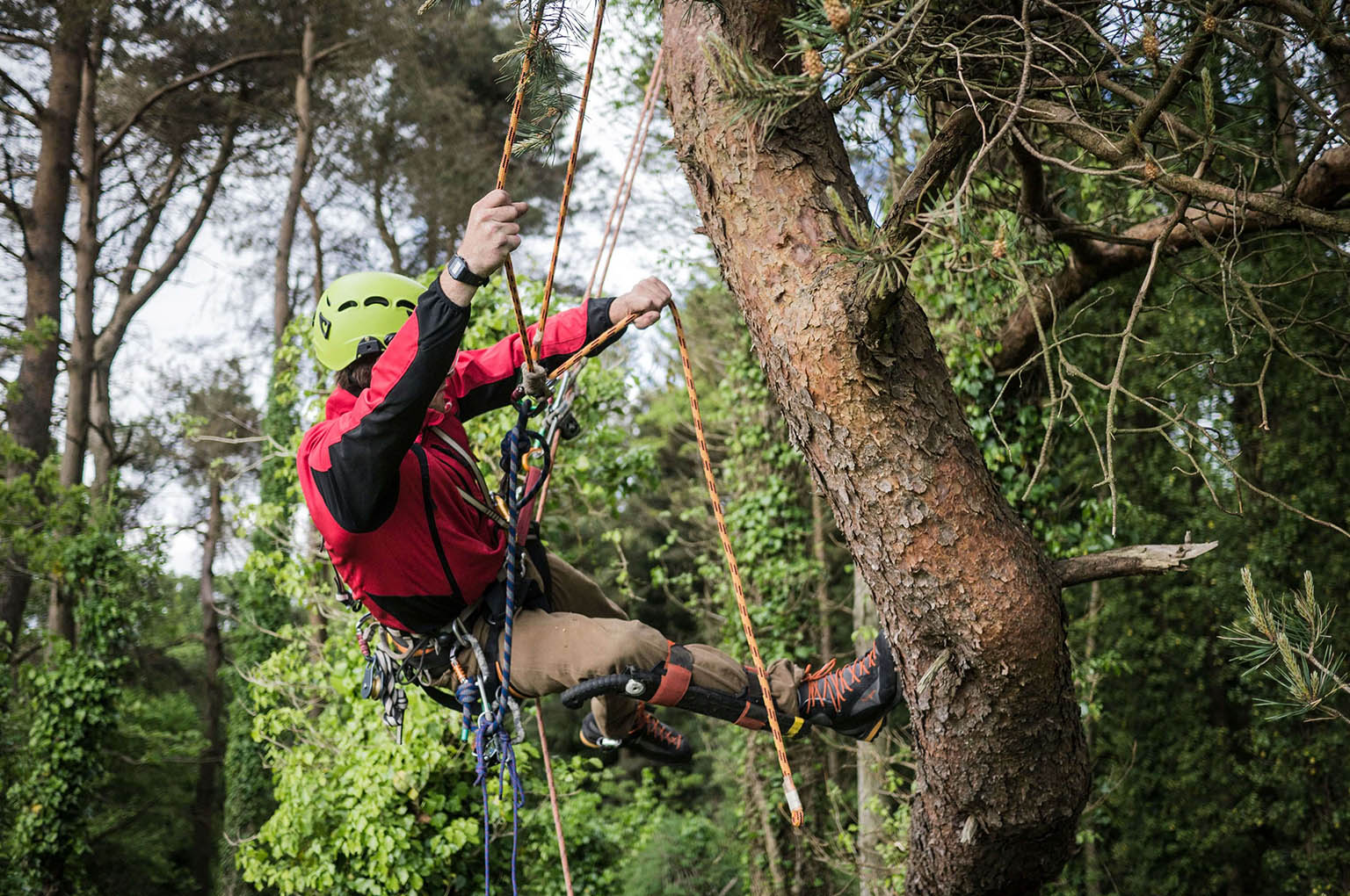
- Uses Spikes to Prune: Spikes (climbing spurs) should only be used for a total tree removal. Using them on a healthy tree causes permanent bark damage and introduces disease.
4. The JC Tree Solution: What We Do Instead
You don’t have to choose between a hazardous giant and a butchered stump. There are safe, arboriculturally sound ways to manage large trees.
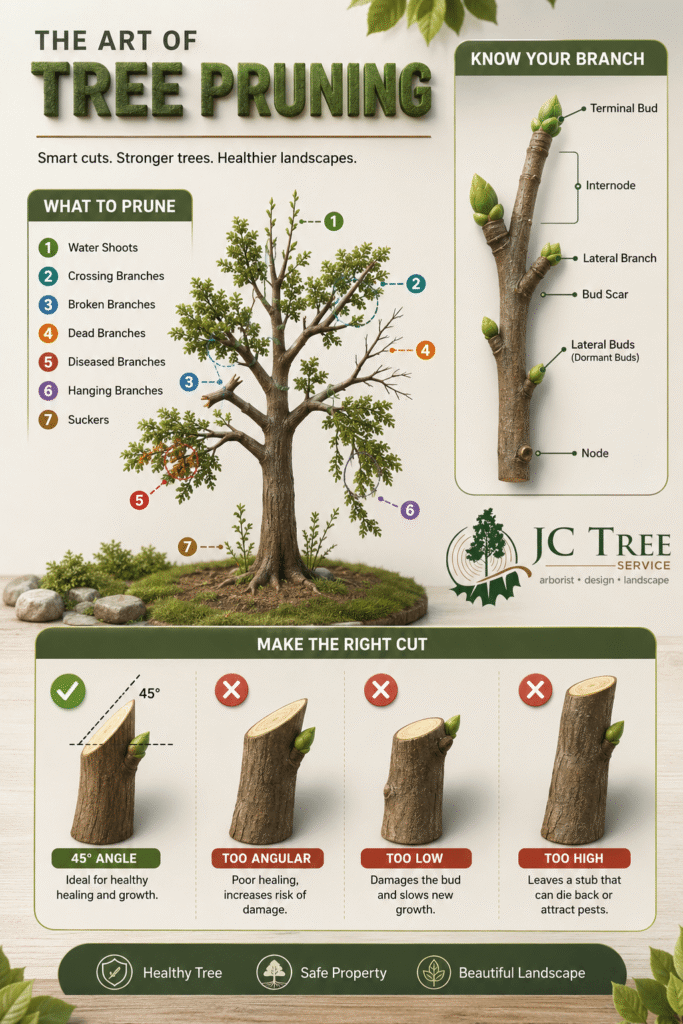
- Crown Reduction (Drop-Crotch Pruning): If a tree is genuinely too tall for its space, we use drop-crotch pruning. This involves reducing a tree’s height by carefully cutting branches back to lateral branches that are large enough to assume the terminal role (at least 1/3 the diameter of the removed branch). This preserves the tree’s natural shape and allows it to heal properly.
- Crown Thinning: Often, the fear isn’t just height, but wind resistance. By selectively removing branches throughout the canopy, we allow wind to pass through the tree rather than pushing against it like a sail. This drastically reduces the risk of the tree blowing over in a storm, without damaging its structural integrity.
Need Help Deciding How to Prune Your Tree?
The right pruning method depends on the tree, its condition, its location, and the problem you’re trying to solve.
Don’t let an uncertified worker turn your valuable tree into a dangerous liability.
Request a Tree Service Consultation →
Frequently Asked Questions About Tree Topping
No. Topping triggers a severe survival response. Because the tree has lost its food-producing leaves, it panics and aggressively pushes out rapid, upright shoots (epicormic growth) to replace them. Within just a few seasons, the tree often grows back to its original height—except the new branches are weakly attached and far more dangerous.
A topped tree doesn’t always drop dead overnight. However, internal decay begins almost immediately because the tree cannot heal flat stub cuts. Over 3 to 10 years, that internal rot hollows out the structural framework. The tree might look green on the outside, but it is rotting from the inside out, turning into a hidden hazard that can snap during a moderate storm.
Don’t panic, but do not top them again. Have a certified arborist inspect the tree to assess internal decay and structural stability. In some cases, an arborist can perform corrective training over several years to re-establish a safer canopy structure; in other cases where rot is too advanced, safe removal may be the only option to protect your property.
Absolutely not. Mature, healthy, structurally sound trees can add 10% to 20% to your property value, provide essential summer shade, and lower cooling costs. Removal should be a last resort for trees that are dead, irreversibly diseased, or permanently compromised by past practices like topping.
Always ask if they employ ISA Certified Arborists. Certified arborists carry credentials from the International Society of Arboriculture, meaning they have passed rigorous exams on tree biology, safety standards, and proper pruning techniques (ANSI A300 standards). If a company suggests “topping” or “hat-racking” a tree, consider it a red flag and look for a qualified professional.